
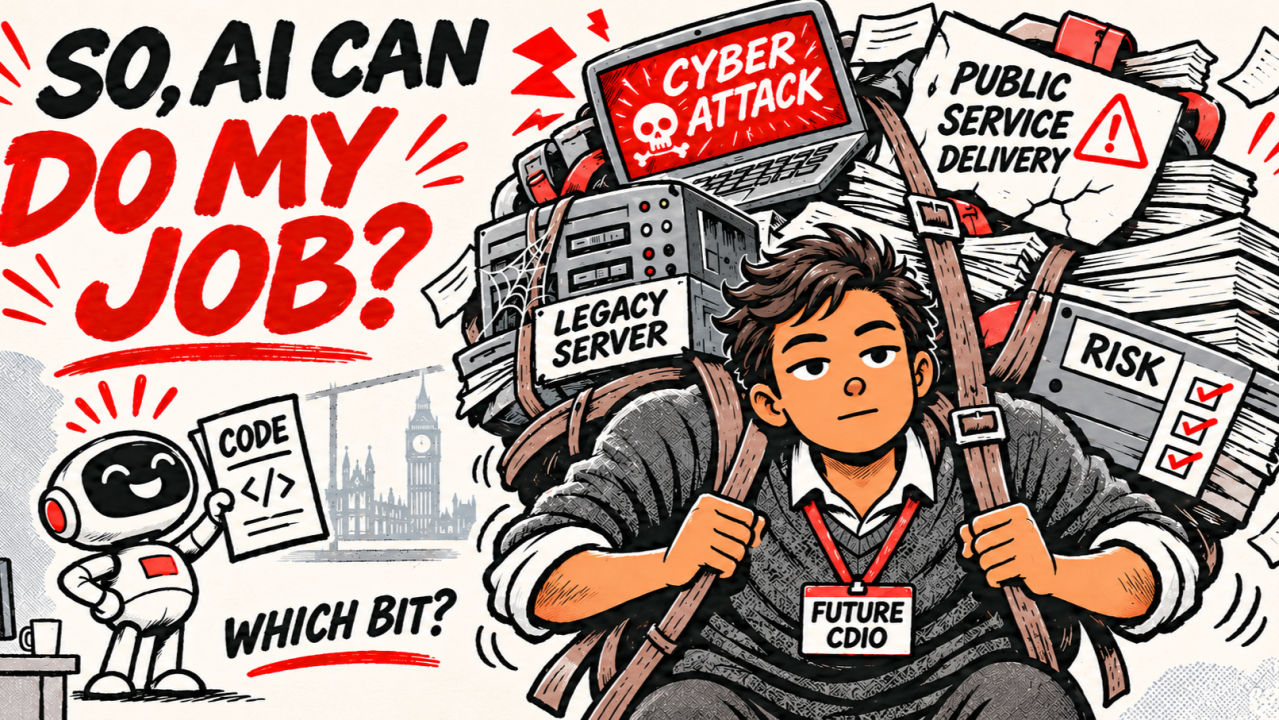
I’ve spent a fair amount of time recently thinking about what the next generation of public-sector digital leaders will look like, it’s an occupational hazard when you spend your working life finding them, and I’ve come to the conclusion that we might be recruiting for some rather different CDIOs in the not-too-distant future.
For years, we’ve worked with public organisations to find people capable of leading increasingly complex Digital, Data and Technology functions. We’ve recruited the people who build things, the people who keep those things running, the people who stop other people breaking into those things, and the people who design strategies explaining what all those things should be doing.
But artificial intelligence is starting to make me question whether the structures we’ve spent years building are necessarily the structures we’ll need in the near future.
Take software development…go on, take it.
We’ve become accustomed to organisations employing sizeable teams of developers, engineers, testers and delivery professionals to build and maintain digital services. Often for good reason. Public-sector technology is complicated, legacy systems are everywhere, and even the most straightforward-sounding programme can become an exercise in archaeological excavation.
But what happens when increasingly sophisticated AI products can do a meaningful proportion of that work?
The government has already tested AI coding assistants, with participating developers reporting average time savings of almost an hour a day. And we’re still relatively early in the development of these technologies. Now I’m not suggesting that we sack all the developers and give everyone a ChatGPT subscription. Although I’m sure there’s a budget holder somewhere considering it.
But surely, we must accept that the amount of human effort required to develop certain types of software is going to change. And if it does, so too will the teams responsible for delivering it.
The other question is what happens to everything else? Because whilst AI might make it easier to build an application, it doesn’t necessarily make it easier to run a complicated public organisation and it certainly won’t fix your laptop for you.
We’ve still got an enormous legacy technology problem across the public sector. Our systems don’t always talk to each other, the data isn’t always particularly useful, and the sector continues to operate services where the consequences of something going wrong are considerably more serious than an inconvenient error message – so adding AI into that environment introduces an entirely new level of complexity.
Someone still needs to understand the architecture. Someone needs to ensure the data is reliable, the systems are secure and the services remain operational. And someone needs to take responsibility when (not if) the wonderful new AI solution confidently produces something completely wrong.
I suspect the demand for those people isn’t going anywhere. In fact, I’d argue that enterprise architecture, cyber security, digital resilience, service operations and data governance are all likely to become more important, not less.
Then there’s digital product…
One of the more encouraging possibilities is that if we spend less time and money physically building technology, we might be able to spend more time understanding what we’re actually trying to achieve with it.
Understanding how citizens interact with public services, how frontline teams operate and how technology can genuinely improve outcomes will remain essential. AI might help us create a solution, but it won’t automatically tell us whether we’re solving the right problem.
This is where I think the structure of a typical DDaT function could become quite different.
Perhaps we’ll see smaller, highly capable engineering teams working alongside stronger architecture, integration and product functions. Greater investment in cyber and operational resilience. Data and AI governance becoming central to organisational decision-making rather than sitting somewhere on the edge of the technology department.
And maybe fewer large, traditional technology directorates, with more capability organised around products, platforms and the outcomes the organisation needs to deliver.
Of course, a major central government department will have very different requirements from a district council, charity, or NHS trust. So, I’m not proposing a universal organisational chart, but I imagine the changes will be similar across sectors, not least when so many have followed in the footsteps of Central Government DDaT. But I do think CDIOs need to start asking whether their current structures reflect where technology is going or simply where it’s been.
Which brings me to the people leading these functions.
Historically, many of the CDIOs we’ve appointed have progressed through fairly recognisable routes. Infrastructure, technology operations, software engineering, architecture or programmes and digital transformation.
All perfectly sensible backgrounds, and I’m certainly not suggesting they won’t remain so. But I wonder whether the balance of experience that makes someone an outstanding CDIO is about to change.
If much of the technology organisations consume is increasingly developed elsewhere, and if AI makes the delivery of certain technical capabilities considerably easier, perhaps the defining skill of a CDIO becomes less about managing the people who build technology and more about understanding how to use it to fundamentally change an organisation.
That requires a rather different combination of skills.
Commercial judgement, organisational design, strategic architecture, cyber resilience, data leadership and a genuine understanding of service transformation will be key. And perhaps, above all, the ability to persuade an organisation to do things differently. Which, as anyone who’s worked in public-sector transformation will tell you, is often considerably harder than building the technology itself.
For existing CDIOs, I think there’s a real opportunity to get ahead of this.
Look at the capability you’re investing in. Are you replacing people because you’ve always had those roles, or because you’re confident you’ll need them in five years?
Are you developing your architects, data leaders and cyber professionals to operate strategically? Are your product teams genuinely responsible for service outcomes? Are you investing enough in the commercial and supplier management skills needed to navigate an increasingly complicated market of AI-enabled products?
And are you developing your own understanding of AI beyond its potential to make people more productive?
For those aspiring to become CDIOs, my advice would be to broaden your experience now.
If you’re a brilliant engineering leader, learn more about organisational transformation and commercial strategy. If you’re a Chief Architect, get closer to the operational challenges facing your organisation. If you lead cyber, data or service operations, look for opportunities to take responsibility for wider business outcomes.
The next generation of CDIO appointments may well favour people who’ve deliberately stepped outside of their technical specialisms and int the realms of others. It’s also possible that we’ll see more credible candidates emerging from product and service transformation backgrounds, rather than the traditional IT leadership route.
As a recruitment business, that’s fascinating for us.
We’re already operating in a market where finding individuals who combine technical credibility with outstanding leadership capability is difficult. Add AI fluency, organisational transformation and commercial judgement into the mix, and I suspect the competition for genuinely exceptional talent will become even more interesting.
But, perhaps, as occasionally my thoughts are…this is all nonsense. Perhaps AI will simply allow public organisations to do considerably more with the technology teams they already have. Perhaps the savings will be reinvested into addressing years of underfunding and technical debt, rather than reducing headcount.
I suspect the reality will be a mixture of both.
But whatever happens, I struggle to believe that the CDIO function of 2030 will look much like the one we’ve become accustomed to today.
We may end up with CDIOs leading smaller technology teams but carrying considerably greater responsibility for how their organisations operate. And perhaps that’s the change that many of us have been waiting for.
For years, we’ve talked about moving technology leadership away from keeping the lights on and towards genuine organisational transformation that threads the other corporate functions together as a leader not just a service provider. AI might indeed finally force the issue.
I’d be particularly interested to hear from those currently leading public-sector DDaT functions.
If you were building your technology team from scratch today, knowing what AI might make possible over the next five years, would you build the same team you’ve got now?
And if the answer is no, what’s stopping you from changing it?
Rob Johnson – Managing Director – Global: Executive Search, Interim & Consultancy (DDaT – Public Sector)
#CDIO #DigitalLeadership #PublicSector #ArtificialIntelligence #DDaT